Village Service Trust has been working for more than 40 years to support marginalised people in their pursuit of lives free from poverty, violence and discrimination in Tamil Nadu, southern India. They work with three partners to provide stable, sensitive and responsive support to the most marginalised people such as Dalit women and children, tribal people, sexual minorities, migrant adolescents and women in prostitution and others. Taking a rights-based approach, they work with community based organisations (including children’s groups) and volunteers to support communities to claim and secure their basic rights and entitlements.
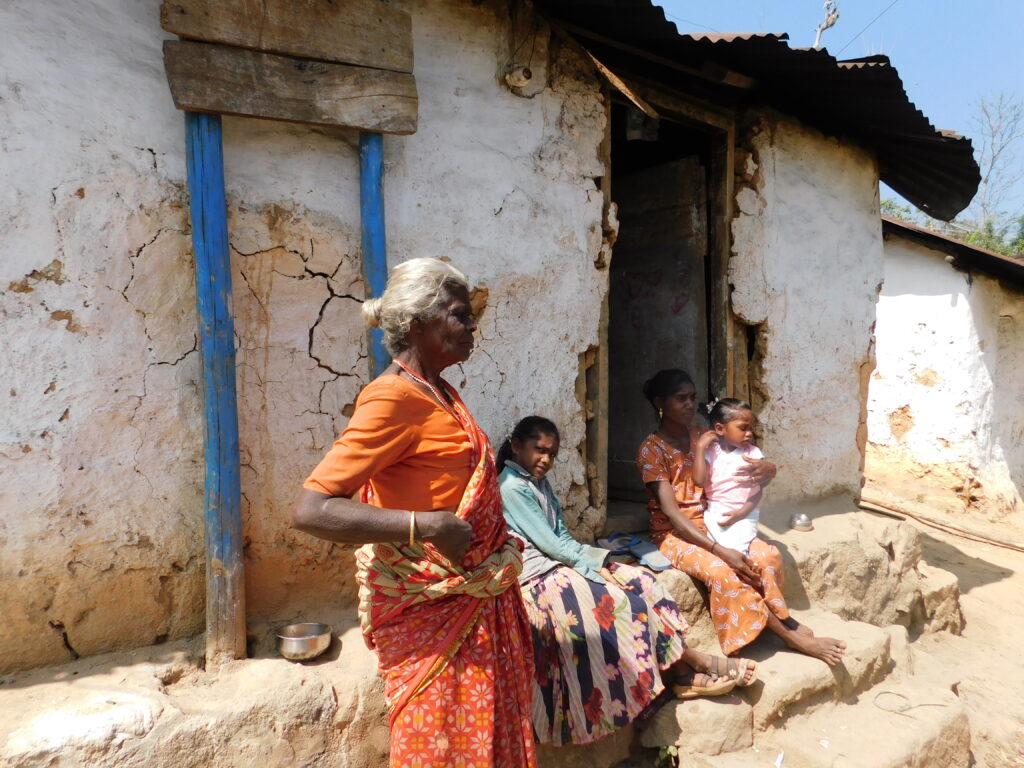
Following a successful pilot, we are now providing 3-year funding for the project which is run by Arogya Agam and works with Women Self-Help Groups in Palliar tribal villages in Dindigul District. These communities are severely disadvantaged and have very limited access to health facilities, schools, transport and basic village facilities. Rights to traditional forest livelihoods are denied and the community is exploited. Working with 31 village communities, the project is increasing women’s development through Self-Help Groups not only for advocacy but to provide financial support to members through internal savings and loans. The project also focusses on improving children’s rights and opportunities, ensuring access to maternal and child health services, providing basic village facilities and improving livelihoods.
Following on from earlier initiatives by Arogya Agam has established 12 new Self-Help Groups across 17 villages bringing the total to 28 with 230 members; they judge that 20 of these are well functioning. There are a number of reasons to explain why a WSHG may not function well and in association with Kurinji, the local women’s federation, they are looking to work with these groups to address such issues. Six well trained volunteers are deployed to help these groups with another 6six to be recruited going forward. Through their advocacy the new Groups have managed to get infrastructure improvements in nine villages – five water tanks, six paved roads, three piped water connections, streetlights for five villages, a playground, school buildings and land for a new school. 600 school age children are monitored with a view to improving educational achievement within the community. Of the 600, 576 are currently enrolled and attending school to 12th Standard (equivalent to A-level years). Of the 15 students taking the 10th standard exams (GCSE equivalent) 12 passed and the other 3 joined technical courses. Of 8 students taking 12th standard exams 6 passed and have gone on to further education.
Central to the livelihood of the Palliars is their access to forest rights and housing benefits. This involves liaison with local government officials whose attitudes toward tribal groups have a major impact on what can be achieved. 563 applications for forest rights are in abeyance but there is more success on the housing front with approval received for 44 of 68 house repairs, 32 of 119 house proofs of ownership and 77 of 81 house plot applications from earlier submissions. 78 houses have been constructed out of the 101 new applications made from early 2025. A similar pattern reflects applications for vital documents essential to the livelihood of the Palliars. Importantly economic permits have been obtained for broom making in two villages with six more being processed; other local based sanctioned activity includes the collection of herbal medicine and the collection of tree honey. 47 individuals participated in horticulture training with numerous other initiatives were put in place to increase work opportunity. It is a constant battle for tribal groups such as these to access their entitlements but the effectiveness of the Self-Help Groups alongside the input from Arogya Agam, whose ability to liaise with local government officials to unblock barriers, is allowing the supported villages to slowly strengthen their communities.